What Is the Percentage of Nuclear Power to Contributions to Electrical Power Worldwide in 2015
Nuclear rut and gross electricity product
The production of nuclear heat is obtained from the fission of nuclear fuels in nuclear reactors. This estrus is subsequently used for the production of electricity. The remaining heat (about 2/3 of the total) is mainly lost, except for a very small part which is used for agriculture and urban heating. The full production of nuclear heat in the EU in 2020 was 175 175 thousand tonnes of oil equivalent (toe), a decrease of 18.seven % compared with 2011.

Table ane: Production of nuclear heat, ktoe, 2011 to 2020
Source: Eurostat (nrg_inf_nuc)
The main employ of nuclear oestrus is the production of electricity. The gross electricity generation from nuclear plants inside the EU in 2020 amounted to 683 512 GWh, which represents a 25.ii % subtract compared with 2006. Over the period 1990 to 2020 ii different trends can be distinguished. From 1990 to 2004, the total amount of electricity produced in nuclear facilities in the EU rose by 26.nine %, reaching a summit of 928 438 GWh in 2004, due to an increase in the number of reactors in performance. Between 2004 and 2006, the total product of nuclear power in the European union stabilised, before declining past 25.2 % between 2006 and 2020, mainly due to a abrupt drop of effectually 61.v % in nuclear production in Federal republic of germany (come across Tabular array 2).
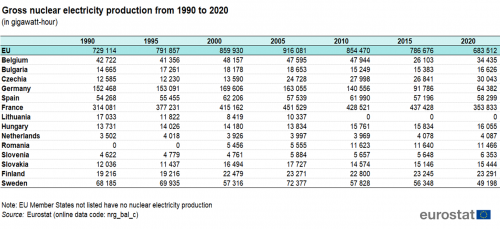
Table 2: Gross electricity generation in nuclear ability plants, GWh, 1990 to 2020
Source: Eurostat (nrg_bal_c)
The largest producer by far of nuclear power within the European union in 2020 was French republic, with a 51.8 % share of the EU total, followed by Germany (ix.4 %), Kingdom of spain (8.5 %) and Sweden (vii.2 %). These four Member States produced 76.nine % of the total amount of electricity generated in nuclear facilities in the EU in 2020. (come across Figure i)
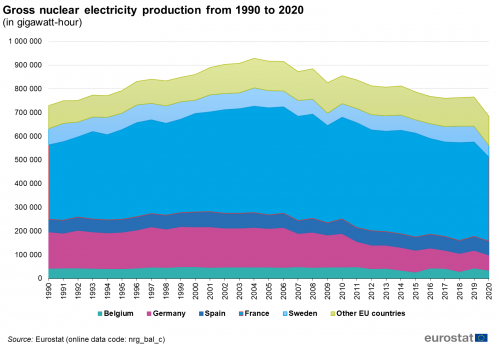
Figure 1: Gross electricity generation in nuclear ability plants, GWh, 1990 to 2020
Source: Eurostat (nrg_bal_c)
Contrary to the full general EU trend, between 2006 and 2020 six countries increased their nuclear electricity production: Romania, whose nuclear ability product began just in 1996 (+103.six %), Hungary (+19.3 %), kingdom of the netherlands (+17.8 %), Czechia (+15.3 %), Slovenia (+fourteen.five %), and Finland (+ane.7 %). During the aforementioned period, the remaining countries (including the principal producers) decreased their nuclear electricity production. Lithuania definitively shut down its nuclear facilities in 2009. Federal republic of germany recorded the highest decrease (-61.5 %), followed past Sweden (-26.5 %), Belgium (-26.2 %), France (-21.4 %), Bulgaria (-14.vii %), Slovakia (-14.3 %), and Spain (-3.0 %).
Enrichment chapters
Uranium establish in nature consists largely of two isotopes, uranium-235 (U-235, fissile) at 0.vii % and uranium-238 (U-238, non fissile) at 99.3 %. U-238 does not contribute directly to the fission process (though it does so indirectly past the formation of fissile isotopes of plutonium 239). Because of the pocket-sized percentage of fissile material in the natural uranium, and in guild to obtain suitable nuclear fuel for the pressurised water reactors (PWR, the majority in Europe), it is necessary to increase the concentration ('enrich') of the U-235 isotope from 0.7 % to 3-v %. At that place are 2 possibilities: the centrifugation or the diffusion of the uranium in gaseous form (hexafluorure UF6). As a result, the natural uranium is separated into a pocket-sized office of enriched uranium and a big role of depleted uranium. Only 2 reactors in the Eu (in Romania - Canadian type "CANDU") use natural uranium. This technology does non require uranium enrichment but requires the use of "heavy h2o" as moderator to compensate.
The standard measure, the "separative work unit of measurement", is the effort required to separate isotopes of uranium (U235 and U238) in the enrichment process: ane tSWU is equivalent to 1 tonne of separative work units (tSWU).
But three Eu Member States operated enrichment plants in 2020: Federal republic of germany, the netherlands and France, bringing the total enrichment chapters of the European Wedlock to 16 600 tSWU (see Table 3).

Table three: Enrichment capacity, tSWU, 2011 to 2020
Source: Eurostat (nrg_inf_nuc)
Production of fresh fuel assemblies
The fuel assembly constitutes the base element of the nuclear reactor cadre. The cloth used is the low enriched uranium (3 % to 4 % U235) produced past the enrichment plants. The standard pressured water reactor core contains about 157 fuel assemblies (depending on the reactor blazon). The uranium oxide (black powder) is pressed into pellets (small cylinders), then placed inside rods (tubes of about 1 cm diameter, 4 m length ) which are inserted into the basic element of nuclear fuel, the "associates". The term "fresh fuel" indicates that it is the get-go utilise of uranium extracted from mines equally opposed to the "MOX fuel" which is mainly made of recycled material. MOX (mixed oxide) assemblies are non included in this department only are covered in section "Production of MOX fuel elements".
Production of fresh fuel elements are measured in tonnes of heavy metallic (tHM).
Only five EU Fellow member States produced fresh fuel elements in 2020: Germany, Spain, France, Romania and Sweden (run across Tabular array 4 and Figure 2), with an overall decrease from 2011 to 2020 of four.5 %. Belgium recorded the largest subtract in production of fresh fuel elements over the by decade as information technology stopped its production in 2012, followed by Germany (-35.9 %) and Kingdom of spain (-15.6 %). France recorded the largest increase (+31.5 %), followed past Sweden (+22.4 %), whereas in Romania the production of fresh fuel elements remained rather stable over the past 10 years.

Tabular array 4: Production of fresh fuel assemblies, tHM, 2011 to 2020
Source: Eurostat (nrg_inf_nuc)

Figure two: Production of fresh fuel assemblies, tHM, 2011 to 2020
Source: Eurostat (nrg_inf_nuc)
Production of MOX fuel assemblies
The product of MOX (Mixed OXide of uranium and plutonium) assemblies is like to the production of fresh fuel assemblies. The difference lies in the use of a mix of uranium oxide and plutonium oxide instead of pure uranium oxide.
The aim of using MOX is the "recycling" of the remaining uranium and the plutonium, both extracted from the spent fuel in the reprocessing plants (97 % of the nuclear material tin can be reused). The MOX fuel is mainly used in France representing 1/four to ane/3 of the full core fuel in some reactors. The production of MOX fuel elements is measured in tHM (tonnes of heavy metal).
As shown in Table five, only two EU countries produced MOX fuel assemblies in 2011: Belgium and France. Nonetheless, Belgium stopped its production in 2015, leaving France as the only remaining Member State with a MOX product chapters.

Table five: Production of MOX, tHM, 2011 to 2020
Source: Eurostat (nrg_inf_nuc)
Production of uranium and plutonium in reprocessing plants
This section refers to the annual product of uranium (U) and plutonium (Pu) in reprocessing plants, measured in tHM. Reprocessing consists of recovering fissile and fertile materials from used nuclear fuel in order to provide MOX fuel for nuclear ability plants. The spent fuel, assembled in rods, is first dismantled, so cut in small pieces, before being chemically separated into uranium, plutonium and waste material. 97 % of the nuclear fabric (U and Pu) is recycled and the remaining 3 % highly nuclear waste material is vitrified and put into containers for long term storage.
As shown in Table 6, French republic is currently the only EU Member State which operates a nuclear reprocessing establish.

Table 6: Production of uranium and plutonium in reprocessing plants, tHM, 2011 to 2020
Source: Eurostat (nrg_inf_nuc)
The production of U and Pu in reprocessing plants in France was on a similar level in 2020 as in 2011, around 1 % lower.
Uranium supply security
Uranium is an abundant resource on all v continents: 44 % is found in OECD countries, 22 % in the BRICS (Brazil, Russian federation, India, Cathay and South Africa) and 34 % in the remainder of the globe. This distribution greatly limits geopolitical risks compared with, for example, oil supply. According to the International Atomic Energy Agency, the identified global resource with low extraction costs represent a century of consumption at the electric current rate. In addition, uranium is a stable metal, which can be stored hands without any fourth dimension limit. Some countries already accept strategic stocks that can be used for years.
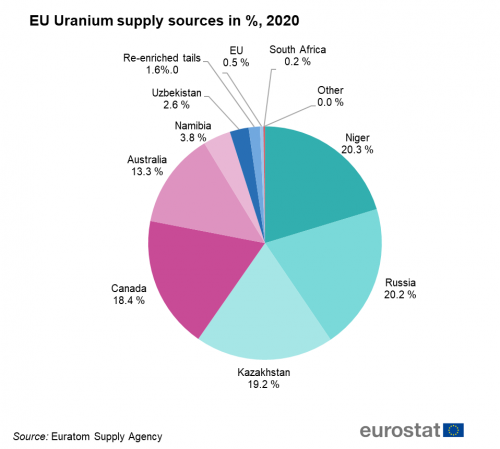
Effigy 3: European union Uranium supply sources in %, 2020
Source: Euratom Supply Agency
Information sources
Annual data on nuclear energy and production of electricity accept been used for all calculations. The most recent data bachelor are for 2020. Information are available for all European union Member States. In general, data are consummate, recent and highly comparable across countries.
Context
The ground for nuclear free energy in Europe was laid in 1957 by the European Atomic Energy Community (Euratom). The initial goal was to develop the civil use of nuclear material (for medical purposes, electricity production as examples). The sector represents an important source of electrical energy, since nuclear power stations currently produce around a quarter of the electricity consumed in the European Marriage.
Energy statistics inform the political controlling in the Eu and its Member States. Statistics on nuclear energy were incorporated in Regulation (EC) No 1099/2008 on free energy statistics. This Regulation states that statistics concerning the ceremonious use of nuclear free energy must be transmitted annually by Fellow member States to Eurostat . This regulation was amended several times and the final amendment (Regulation (EU) No 2019/2146) entered into force on 5/1/2020. The forthcoming sixth amendment is expected to enter into force in the get-go quarter of 2022. The link to the legislation page on Eurostat's website is here.
In view of finding solutions for achieving the European union'southward decarbonisation goals, the European Commission launched an in-depth assessment in 2020 on the possible inclusion of nuclear energy in the EU taxonomy of environmentally sustainable activities. Equally role of this assessment, the Joint Research Centre drafted a technical written report on the 'do no significant damage' aspects of nuclear free energy. After reviews of the report by ii independent expert groups, the Commission prepared a draft text of a Taxonomy Complementary Delegated Act covering certain gas and nuclear activities. On 31 Dec 2021, the Commission launched a two-week consultation on the draft text with the Member States Expert Group on Sustainable Finance and the Platform on Sustainable Finance. After conscientious analysis of the Expert Group's contributions, the Commission will formally adopt the complementary Delegated Human action in January 2022, before sending it to the European Parliament and the Council for scrutiny.
Source: https://ec.europa.eu/eurostat/statistics-explained/index.php/Nuclear_energy_statistics
0 Response to "What Is the Percentage of Nuclear Power to Contributions to Electrical Power Worldwide in 2015"
Post a Comment